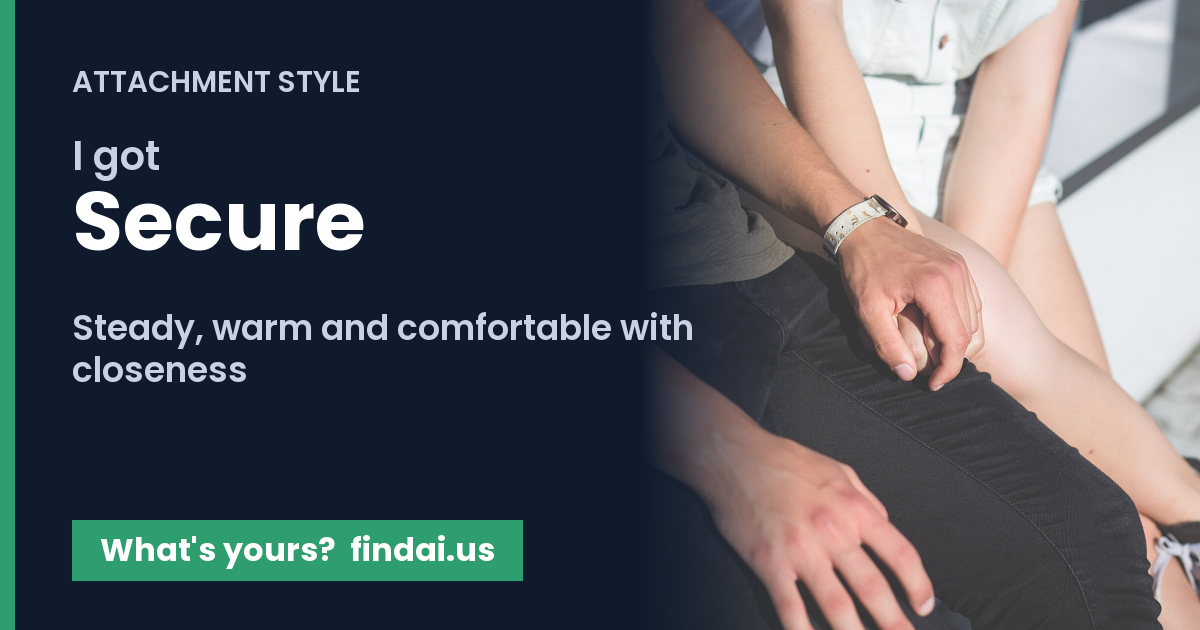
Attachment Style · result
Secure
Steady, warm and comfortable with closeness
Steady, warm and comfortable with closeness
You tend to feel comfortable with closeness and with independence. You can ask for what you need, give others room, and trust that a rough patch doesn't mean the end.
If you got Secure, your answers suggest you feel fairly at ease in close relationships. You can enjoy being near someone without losing yourself, and you can spend time apart without assuming something is wrong. When a text goes unanswered, you figure they're busy. When there's a disagreement, you'd rather talk it out calmly than win or run.
In attachment theory, security doesn't mean you never feel jealous, hurt or insecure. It means those feelings tend to pass without taking over. You can say "that bothered me" without making it a crisis, and you can hear a partner's complaint without feeling attacked. Security is often built from experiences where people showed up reliably, but it can also be learned later in life through healthy relationships.
It also shows in how you handle the in-between moments. You don't need constant contact to feel connected, and you don't panic when plans change. You can tell the difference between a partner having a bad day and a relationship being in trouble, which keeps small bumps small.
You're usually the one who says what you mean. You check in when your partner seems off, and you believe them when they say they're fine. You can make plans together and keep your own friendships and hobbies without guilt. Apologizing isn't scary for you, and neither is forgiving. Partners often describe you as easy to be around, not because you're always calm, but because you're consistent.
You also tend to set reasonable boundaries. You can say no to a plan, or ask for space, without feeling like you're risking the whole relationship. That makes you a steadying presence, especially for partners who lean anxious or avoidant.
Secure people can still slip into old habits under stress, or stay too long in a relationship because they're good at working things out. Your patience is a gift, but it isn't an obligation. It's okay to expect the same effort and honesty you give.
And remember, this quiz is a reflection tool, not a diagnosis. Most people have a mix of styles, and the way you attach can look different with a partner, a parent or a best friend. If you want to go deeper, our guide to attachment styles explains where these patterns come from.
Be honest and consistent. A secure partner values straightforward talk, follow-through and the freedom to have a life outside the relationship.
Velour tracksuits or studded belts? Popped collars, skate shoes, fringe or a handheld console? Ten quick questions reveal your early-2000s aesthetic.
Take the quiz →Vintage film, oil painting, cyberpunk, watercolor, 90s yearbook or comic book? 10 quick questions reveal the AI photo filter style that matches your vibe.
Take the quiz →Cozy night in, adventure, foodie, culture, spontaneous or nostalgic? Answer 10 fun questions to find your perfect date night, then compare.
Take the quiz · Duo mode →